Posted by Ahni on December 4, 2009 at 4:01pm www.intercontinentalcry.org
The Internal Revenue Service (IRS) has auctioned off 7,100 acres of land belonging to the Crow Creek Sioux Tribe in central South Dakota, one of the most impoverished reservations in the United States.
The land was sold on Thursday in a bold but hardly shocking attempt by the IRS to recover $3.1 million in federal employment taxes, penalty charges and interest that was owed by the Tribe.
According to a recent lawsuit filed by the tribe, the IRS acted unlawfully because the land is owned by Crow Creek Tribal Farms Inc., a corporation formed under Tribal law.
The lawsuit further contends that the Bureau of Indian Affairs (BIA) misinformed the tribe, telling them “that, because it was a federally recognized Tribe, it was not necessary to pay federal employment taxes.â€
“It’s very disgraceful, very shameful. It’s devastating to us,†said Tribal Chairman Brandon Sazue, who was in attendance at the auction. “Our land is never for sale.â€
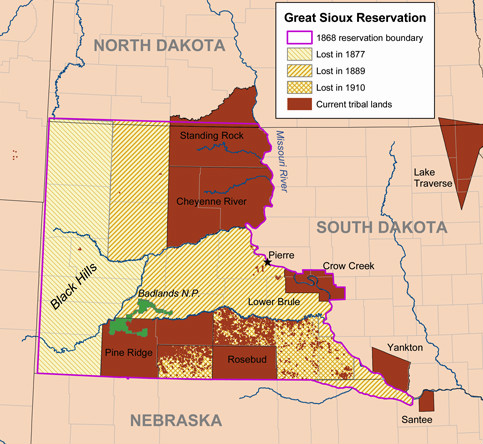
In addition to this, the land is a part of the Crow Creek Indian Reservation, which was established by the 1868Â Treaty of Fort Laramie.
Just prior to the treaty, in 1863, the US government established Fort Thompson some eight miles from the Crow Creek tributary in South Dakota. Fort Thompson was a military-controlled site, which also served as a prison camp following the 1862 mass hanging of 38 Dakota warriors. Rarely mentioned in history books, it was the “largest public mass execution in American history.â€
The site became occupied by descendants from several members of the Lakota, Nakota, and Dakota Sioux, who eventually came to refer to themselves as “Hunkpati†(the making of relatives, to live).
When the 1868 Treaty was signed, it brought the reservation into Trust Status. However, the United States government honored the treaty for just six years, until General George A. Custer arrived with the 7th Cavalry to try and capture the Black Hills. The invasion ultimately led to the 1876 Battle of Little Big Horn.
One year later, the US Government unilaterally granted itself title to the Black Hills through the Allotment Act of 1877. Also known as the “Sell or Starve Bill,†the act further divided Sioux lands into individual plots of land which were then handed out to Sioux males .
In 1889, the government took things even further, by removing Crow Creek from its Trust status and selling plots of lands to non-Indians. A 7,100 acre swath was purchased by LeMasters, who held onto the land until Crow Creek Tribal Farms bought it from them in 1998
The company bought the land to consolidate the Tribes land base, explains the lawsuit, and to ultimately ensure an economic future for the tribe. Crow Creek, like other every other reservations in the region, is considered to be a prime location to make renewable energy from the wind.
The reservation isn’t willing to give up the hope. Not when the alternative is abject poverty.
 l3wis
l3wis