TIFs

What’s going on with the Sioux Steel TIF in Downtown Sioux Falls?

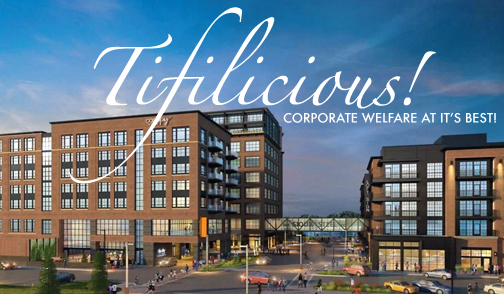
Speaking of ‘Tifilicious’ while our city council is drooling over another ridiculous $94 million dollar tax rebate slush fund to dangle carrots at Asian investors, while we have gotten the shaft on the Midco Aquatic Center windows (still waiting to hear the final on that) and the failed HVAC at the City Center (haven’t heard a peep about that either) or the $26 million dollar bunker ramp to nowhere with a foundation that could hold an aircraft carrier (still no clue how that lawsuit is going either) we have another ‘Tifilicious’ project kind of just flopping in the wind; Sioux Steel project.

As we learned last year due to Covid, the project was delayed and had to be revamped. Understandable. My suspicion is if this project ever does get going again, it will be mostly apartments since Covid has kind of made office space and hotels not a very good investment. But I am wondering 1) why the original TIF hasn’t been rescinded (especially with the South Korean Egg Roll factory TIF on the horizon) and what’s going on with it?

Usually if construction projects are going to break ground in late spring or early summer, the deal is done by February, but we have not heard a peep. I think if the city council doesn’t hear the revamped plans by Feb 1st they need to rescind the original TIF immediately. I have a feeling we won’t see any groundbreaking in 2021 for this project. Maybe they should look into building a Canadian frozen burrito factory on the land, that’s a sure fire way to get a TIF!

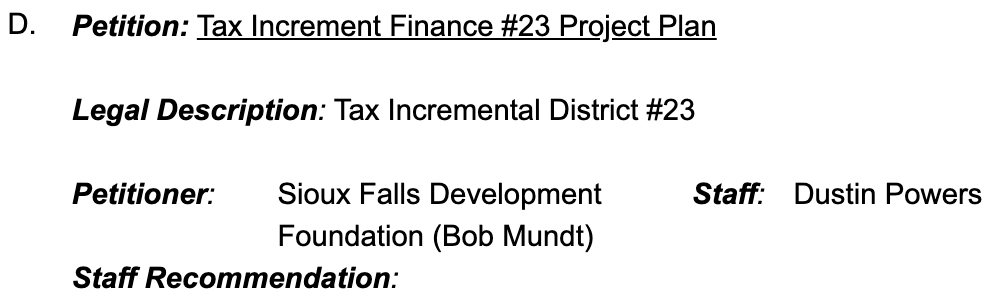
Breaking Down proposed Sioux Falls TIF 23

During public input today at the Sioux Falls City Council informational meeting (FF: 1:39:00) I touched on the morality and ethics of tax incentives and rebates for citizens and local contractors and business owners opposed to International Companies. What I did not touch on is what this TIF is really about, a select group of investors making a buttload of money while using the city as collateral.

Before reading anymore, I encourage you to first watch the presentation of TIF 23 than consider what I think I saw;

• The real beneficiary of the TIF would be the Development Foundation, not the businesses coming in or the citizens of the city.

• Basically the DF is using the TIF as a slush fund (for about 15 years) to make the land more appealing by spending the money on upgrades and infrastructure instead of putting it back into the existing city infrastructure for street improvements, public education or judicial/public safety expenses. In other words they are robbing from the other governmental entities (that benefit us all with their services) to build an industrial park we never needed to begin with (seriously folks, it was much better as farmland).

• Do you think this slush fund will just sit in a metal box down at the executive offices of the Foundation? Nope, now we bring in the banksters and bond salesmen to get their cut while they use the city (taxpayers) as collateral if any of these deals fall thru.

I ask a simple question; If you had two choices as the Mayor and City Council where you could spend $94 million in tax incentives/rebates over the next 15 years? Would you . . .

• Spend it on upgrading existing infrastructure in our city which would improve neighborhoods, reduce crime, create much needed affordable housing, employ local contractors and enrich local small multi-housing property owners or would you . . .

• Spend it on building NEW infrastructure (that we will eventually have to maintain) that will house International and National businesses (which pay substandard wages and little in local taxes while shipping profits overseas) attracting more people to our city who will be looking for housing, public education and creating more social headaches.

Don’t get me wrong, I don’t have an issue with attracting good employers to our city, but why do we always have to dangle the TIF carrot? If our economy was truly strong in Sioux Falls (I think a certain sector of it is) why would we have to offer property tax breaks? If a business truly has a good business model, they should have no problem paying for land upgrades, infrastructure upgrades, living wages and 100 percent of their property taxes on day one. Isn’t that what Free Enterprise and Capitalism is founded on? Not to sound like Ayn Rand, but Cheese & Rice!

But like I said, TIF 23 isn’t about investing in any of these things it is clearly about a handful of bloodsuckers who want to scrape up the fat drippings from the bottom of the broiler pan while our council and city administration is either too blind, too dumb* or too paid off to see it.

*During the Q & A session Councilor Marshall Selberg (who was actually awake for a meeting for once) asked if he could build a Burger King out there. Remember, Marshall is NOT a self-employed piano teacher, he has worked in commercial real estate for a very long time. After asking his question of the DF director, Bob responded, “It’s an industrial park, you can’t build a Burger King out there.” Think about that the next time you hire Marsh as your realtor. Whopper’s are on me!!!!

Should the Sioux Steel TIF be rescinded?

As we have been hearing through sparse media reports, the project is on hold until 2021. What does this mean? Well, it means if it does rear it’s head next year, and that’s a big if, the project may change. This of course means the TIF would be null and void. I have encouraged councilors to rescind the TIF ASAP and get it off the books until we actually know what is going to happen.

Further Proof TIFs provide little to no economic impact

There has been some people asking me lately ‘What’s going on with the Sioux Steel project?’ I have no idea. There have been rumors that since the land snafu was discovered there has been a state investigation. Don’t know. Some also are wondering if investors have pulled funding due to Covid. Don’t know. Either way, good times or bad, state land deal aside, TIFs are worthless and only benefit the developer.

This story shows after 30 years, and $500 million in TIFs there has been virtually NO economic impact.

The results were persuasive: the CTBA study found no evidence that the massive package of tax incentives made a long-term difference to the economic well-being of Hoffman Estates compared to that of other similar nearby suburbs that did not make such corporate deals.

Simply put, the study found that the Sears deal was the economic equivalent of an energy drink: It provided a jolt of caffeine and sugar that quickly wore off.

The truth is, Hoffman Estates and its neighbors were already primed for strong economic growth when the Sears deal was hashed out in 1989.

This has often been one of my biggest arguments against TIFs in Sioux Falls. The developers are already doing well (well at least up until Covid hit). We have had record breaking building permit valuations 6 years in a row even without all the public buildings and non-profit facilities that pay NO property taxes. Why would developers need an incentive? TIFs are, and remain to be developer welfare and little else.

Hoffman Estates and Illinois provided $536 million in incentives to Sears to build its headquarters and other development projects. Despite the infusion of funds, Hoffman Estates’ property values trended the same as other, nearby towns that did not spend nearly as much in tax breaks. (Chart: Lylla Younes Source: Illinois Department of Revenue)

Seney Island, Sioux Steel Development Controversy

Guest Post Bruce Danielson

The recent story (Land ownership question hovers over $185 million Sioux Falls redevelopment plan) of Seney Island tripped a few issues long ago buried in the back of my mind. I have no dog in the show being presented in the Sioux Steel – Seney Island project, but I feel the history of the project needs to include a proper land title search being performed and then presented.

SEE ALL MAPS HERE.

Also, the interesting bit of data in the article claims 160 acres being granted but the original 1859 clearly shows the town lot company survey had the planned layout and 1865 – 1869 maps show the Fort Sod fortification lines of the new settlement. From my research of many years ago, there would not have been a granting of homestead rights in the 1860’s to land already committed to being a townsite.

The enclosed image of the original survey 1859 map of Sioux Falls, shows Seney Island and the village platting. These discrepancies have bugged me to the point where I matched the 1859 images over a current Google Earth image of Sioux Falls. Though not perfect, it does show the relationship of the Island and most of the Sioux Steel property being on Seney Island.

The 1881 drawing shows the relationship of Seney Island to the coffer dam rerouting the water for the mill.

For over 40 years I have heard from old-timers and read stories of how the west channel or oxbow of the Sioux River was used as the original community landfill until it closed it to navigation. The main channel of the Sioux had to be changed to allow for the dam to produce enough water for the mill and power plant.

The 1900 photo of the west channel shown in your story, was the result efforts to fill in the river channel. The old-timers I knew, used to tell stories of the smells coming from the rotting debris leeching to the surface until it was finally covered over. As the property is now being readied for a new purpose, opening up the land could bring back the environmental issues long ago covered up.