2014

MLK the Radical?

King_Jr_Martin_Luther_093.jpg

Don’t get me wrong, love listening to MLK. On the way back from the cities we were listening to past speeches by him. Incredible stuff. I said to my friend, “Can you imagine what the pundits would say about King today? They would accuse him of being negative and a radical. I mean, who complains about being poor and screwed over by the upper class, c’mon, get off your lazy asses and get a job, and if you have one, work harder.”

We could use a little MLK these days.

What happened to Barton Kestle? Art mystery.

More Real? Art in the Age of Truthiness; Mark Dion; Curator's Office; 2011-2012

I made a trip to the MIA this weekend, and they have ‘period rooms’ the most intriguing was the one of the first Modern Art curator:

On March 27, 1954, Barton Kestle, first curator of modern art at the Minneapolis Institute of Arts, boarded a train for Washington, D.C., and was never seen again.

A shy specialist in the Soviet Avant-Garde, Dada, and Surrealism, Kestle had usually worked late into the night at the museum’s grand McKim, Mead, & White building, his office placed near the front entrance so he wouldn’t trip up alarms. This explains how staff came to accidentally seal and paint over his door during a rushed construction job some time in the ’50s.

Two years ago, employees found his door and stepped into Kestle’s world.

Can you FREAKING IMAGINE finding this? If I had the money, I would love to do a private investigation as to what happened to Barton (my guess is he was labeled as a communist spy, and found a ‘special fate’) But his office? What a trip.

I also enjoyed this take of Kestle;

Mark Dion’s “Curator’s Office” (2013), a small room installation, is ostensibly the workplace of one Barton Kestle, a mythical curator of modern art at the MIA. The work is diverting, but carries a hint of tragedy and a sly dose of, to use some artspeak, “institutional critique.” The quiet and unassuming Kestle, a wall label tells us, boarded a train bound for Washington, D.C., and was never heard from again. His office—containing such tools of his time as an Underwood typewriter, metal card-file drawers and a dial telephone—was supposedly walled off when the museum did some renovating. It was “rediscovered” only when interior reconstruction began for “More Real?” Kestle’s fate is a little dig at the MIA, implying that supporting modern art in early-1950s Minnesota might have made a man want to disappear.

The 10th Annual AM950 Blue State Ball

franken-1-17-14

A friend and I attended the VIP portion of the ball Friday night in Minneapolis at the Aria Events Center, AM 950 is a progressive talk radio station. While some of the people we wanted to talk to were no shows due to sickness (Stephanie Miller, Ed Shultz and Gov. Dayton) We did meet a ton of others in the progressive movement in Minnesota. We were able to grab Franken’s ear long enough to warn him about the mess Lewis & Clark has turned out to be (he is a big advocate). We also met the station’s owner, and the morning host (he has covered Sanford’s presence in Minnesota, and I may get an interview with him on his program about Sanford’s influence in Sioux Falls.) Another chance meeting was with a Minneapolis School Board member who also sits on a National Committee of School Board members. She may send me some information about Common Core, her feelings on the curriculum were very interesting.

The common feedback we received is how South Dakota seems to be the black hole of politics when it comes to Republican corruption and domination. You could sense, a lot of people felt sorry for us, and if the drinks weren’t complimentary that night, I have a feeling we would have still drank for free.

But the highlight of the night was meeting the unapologetic, liberal talk host, Mike Malloy. Mike has been fired from about every major news organization in the country, and now produces his show from his home.

mikemalloy

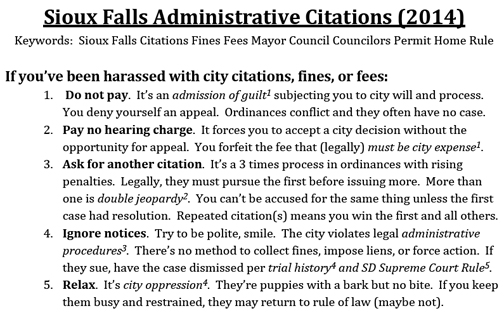
Dan Daily sends out letter to suspected code enforcement violators

Not sure if you know it, but the city has a webpage that lists all the peeps and bizzos that have received code enforcement violations (apparently this is more pertinent PUBLIC information then knowing TIF investors 🙁

Mr. Daily decided that he needed to educate these ‘supposed’ violators and sent them a letter explaining their rights. Not sure what the response has been, but it is intriguing, none the less.

THE ENTIRE DOCUMENT: Code-Violations

code

It seems the only thing city government has learned from history is to repeat itself

small_men_paving_street

Do I believe in keeping up with the historical aspects of our city? Yes. Do I think historical paver stones need to be replaced? Yes. Do I think it is a wise for SF taxpayers to be footing the bill? NO;

A $16,000 grant will help pay for the restoration of a central Sioux Falls alley where the 19th and 21st centuries collide.

Quartzite paving stones in the alley connecting Sixth and Seventh streets between Duluth and Summit avenues are to be removed this summer. City workers will pour a concrete subsurface, then relay the pavers.

With help from the South Dakota State Historical Society’s Deadwood Fund grant program, the city’s cost will be around $175,000.

While I do think that the street department has some financial obligation, I don’t think we need to foot the Lion’s share of this project. I think the city’s role should be making sure the project is done correctly and zoning is in place to do this type of infrastructure work, beyond that, I think either private donations, grants (which are already being used) or adjoining property tax assessments should pay for this project. I scratch my head when the city forces businesses and homeowners to build city sidewalks at their expense, but we drop a cool $175,000 in a neighborhood because it is ‘historical’. Fine. Make them pay for it. It is no different then citizens fixing the city sidewalks.

Besides, with all the discussion about public transit costing the city so much each year, it seems ludicrous we would be spending tax dollars on pavers in an alley. It seems the only thing city government has learned from history is to repeat itself.